Free I Ching oracle
Toss the coins, receive your hexagram
The I Ching, or Book of Changes, is a 3,000-year-old Chinese oracle of 64 hexagrams. Hold a question in mind, cast six lines with three coins and read what the moment is showing you.
Your hexagram
Hold your question in mind as you toss. Lines appear here from the bottom up; gold lines are changing lines.
- Line 1Not cast yet
- Line 2Not cast yet
- Line 3Not cast yet
- Line 4Not cast yet
- Line 5Not cast yet
- Line 6Not cast yet
Core ideas
The language of the oracle
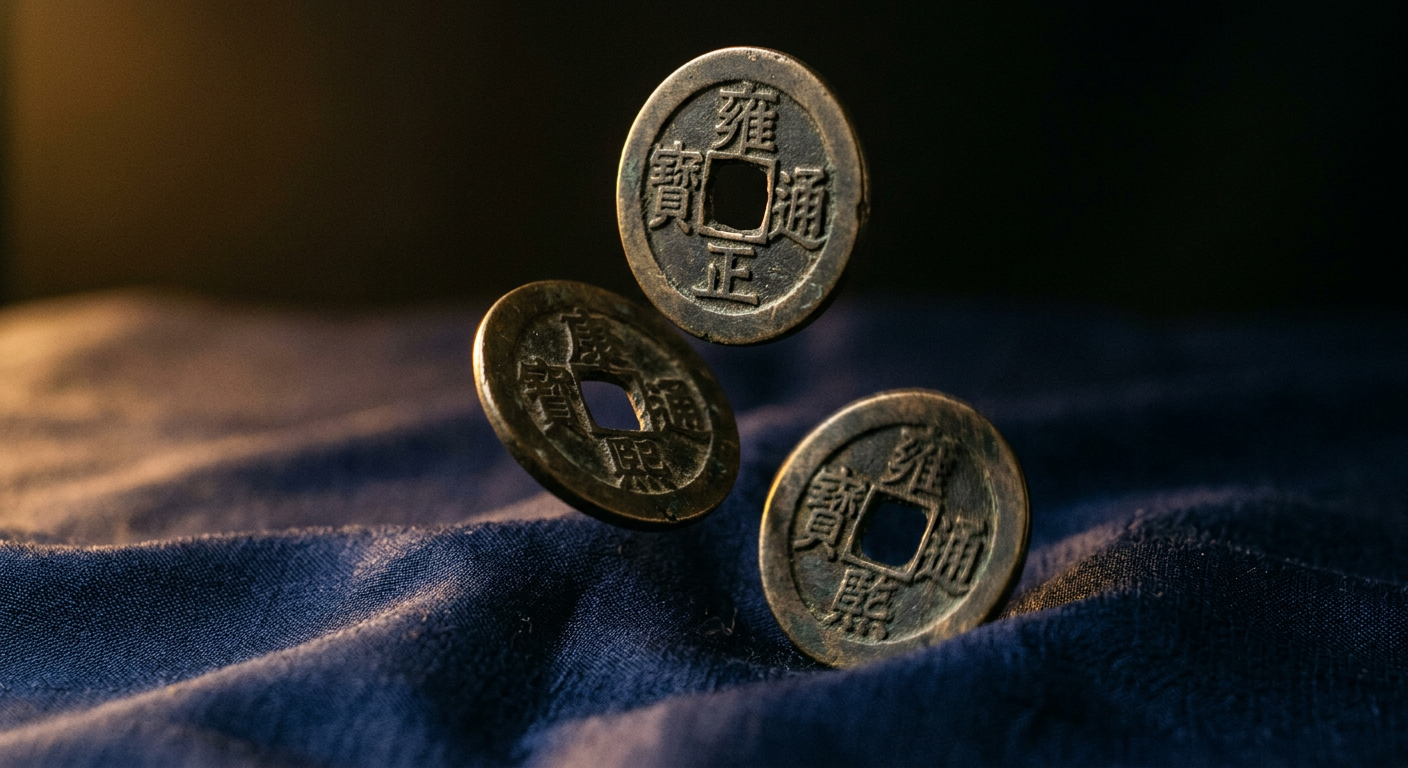
The coins
Each toss of three coins forms one line. Six tosses, built from the bottom up, create your hexagram.

Yin and yang
Broken yin lines are receptive and yielding; solid yang lines are active and firm. Every hexagram is a balance of the two.

Change
The I Ching sees life as constant movement. Changing lines show where your situation is shifting and where it may lead.
How the three-coin method works
Coins become lines
Three coins are tossed for each line. Heads count 3 and tails count 2, so every toss totals 6, 7, 8 or 9. Odd totals make a solid yang line and even totals make a broken yin line.
Changing lines
A 6 (old yin) or a 9 (old yang) is a changing line. It carries extra weight in the reading and shows where your situation is in motion.
The relating hexagram
When changing lines turn into their opposites, they form a second hexagram. It points to where the situation is heading if the present trend continues.
Your coin tosses are random and your hexagram is calculated with the traditional King Wen sequence. Interpretations are generated automatically by AI for reflection and entertainment only, are not written by Pandith Vikram, and are not a substitute for medical, legal or financial advice.